Linear Operator
Definition
A linear operator is a linear map from a vector space to itself, so it has the form .
Interpretation
A linear operator is a linear map that stays inside one space: input and output are vectors of the same vector space . This makes repeated application meaningful, because the operator can be applied again to its own output.
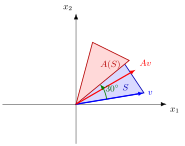
The illustrated operator rotates every vector of the plane by about the origin and is represented by . The triangle and the vector are moved to and in the same plane. Its domain and codomain are the same space, so powers represent repeated application: rotates by , and rotates by , which is the identity.
The only difference with a general linear map lies in the codomain. For with , the composition makes no sense, since is not defined on . In matrix terms, an operator on is given by a square matrix, and powers exist only for square matrices.
The same formula can give an operator or not, depending on the codomain: is an operator on , while , from to , is not. Questions such as which vectors an operator only stretches, or whether its effect can be undone, are asked for operators and return later as eigenvectors and inverses.
Key Results
- The set of linear operators on is denoted .
- Eigenvalues, determinants, inverses, and diagonalization are concepts for linear operators or their square matrix representations.
Examples
- The identity map is a linear operator on .
- The derivative is a linear operator on the vector space of polynomials.
Prerequisites
Related Concepts
Sources
- Math II: Linear Algebra · Week 3
Aliases: linear endomorphism Keywords: endomorphism Symbols: real numbers
Last updated: 20 October 2026 03:02
Linear OperatorEigenbasisEigenvalue and EigenvectorInvariant SubspaceLinear MapVector SpaceMatrixProduct of Linear MapsIdempotent Matrix