Polynomial
Definition
A polynomial is a function formed by adding together finitely many monomials, and the highest degree of all monomials that appear in it is called the degree of the polynomial.
Equivalently, a polynomial is an expression that can be built from constants and symbols called variables by means of addition, multiplication and exponentiation to a nonnegative integer power, i.e.,
where are constants that are called the coefficients of the polynomial.
Interpretation
Polynomials are the functions built from the variable and constants using only addition and multiplication, so they are the easiest functions to evaluate and to work with. Every polynomial is a finite sum of monomials whose exponents are nonnegative integers.
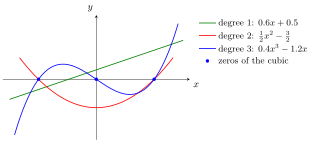
The figure shows one polynomial of each degree , and . The line has one zero, the parabola has two, at , and the cubic has the three marked zeros , and .
Change the coefficients and count the real zeros: a polynomial of degree has at most of them, and setting lowers the degree.
The degree is the largest with , and is the leading term. For large it outweighs all other terms, so the sign of and whether is even or odd decide the shape of the graph far from the origin: the cubic in the figure rises on the right and falls on the left. The degree also bounds the number of zeros: if , then for a polynomial of degree , and repeating this shows that a polynomial of degree has at most zeros.
A common slip is to call every algebraic expression a polynomial. Functions such as and are power functions, not polynomials, because their exponents are not nonnegative integers. Quotients of polynomials form the rational functions, and Math II studies the zeros of polynomials with complex numbers in the fundamental theorem of algebra.
Key Results
- Polynomials are continuous, differentiable everywhere; the derivative of a polynomial is again a polynomial, so polynomials can be differentiated any number of times.
- The degree of a polynomial controls its long-term behaviour.
- Zeros of polynomials determine factorization.
Examples
- is a polynomial.
- Nonzero constant functions are polynomials of degree zero; the zero polynomial is not assigned a degree.
Prerequisites
Related Concepts
Sources
- Math I: Calculus · Lecture 4
Symbols: square root
Last updated: 20 October 2026 03:02
PolynomialRational FunctionAlgebraically Closed FieldCharacteristic PolynomialFundamental Theorem of AlgebraPolynomial Long DivisionRoot of a PolynomialPolynomial on R^nTaylor PolynomialWeierstrass Approximation TheoremMonomial and Power FunctionPower SeriesExponentiation and PowerPolynomial Greatest Common Divisor