Disjoint Sets
Definition
Two sets and are said to be disjoint if they intersect emptily, i.e.,
Interpretation
Disjoint sets share no common elements: an element of one set is ruled out of the other. The condition concerns only their intersection, not how the sets are described.
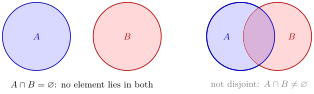
In the left panel the discs and have no common points, so . In the right panel the shaded overlap contains points of both sets, so the sets are not disjoint. A single common element is enough to break disjointness, however small the overlap.
Disjointness makes counting additive: for disjoint finite sets, , because no element is counted twice. A set and its complement are always disjoint, and so are and . For more than two sets, "pairwise disjoint" means that every two of them are disjoint; this is stronger than an empty common intersection, as , and show.
This notion formalizes the idea of mutual exclusivity in probability: events that cannot happen at the same time.
Key Results
- If and are disjoint finite sets, then
- Disjoint sets are distinct, with one exception: so the empty set is disjoint from itself. It is the only such set, because
Examples
- The sets and are disjoint.
- Any set and are disjoint.
Prerequisites
Related Concepts
Sources
- Math I: Calculus · Lecture 1
Symbols: intersection, union
Last updated: 20 October 2026 03:02
Disjoint SetsConnected and Disconnected SetsIntersection of SetsEmpty SetDifference SetComplementDisjoint Events