Fundamental Theorem of Calculus Part 2
Theorem
Suppose are real numbers, and let be a Riemann integrable function. If is an antiderivative of then
Interpretation
This part of the fundamental theorem turns the evaluation of a definite integral into a subtraction. Once an antiderivative of is known, the limit of Riemann sums equals , and no sums have to be computed.
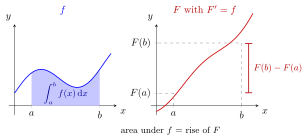
The left panel shows the area under between and ; the right panel shows an antiderivative , which climbs from to . The theorem says that these are the same number: the area accumulated under equals the total rise of . Where is large, climbs steeply, and where is small, is nearly flat.
The reason is a telescoping sum. For a partition , the mean value theorem gives points with . With these tags the Riemann sum is exactly , for every , so the integral is as well.
Both hypotheses are needed. The integral must exist: with is differentiable on , but is unbounded near and therefore not Riemann integrable. And must be an antiderivative on all of . The function has derivative for , yet its difference between and is , while ; it jumps at , so the theorem does not apply to it.
Later, the rules of integration by parts and substitution combine this theorem with the product rule and the chain rule.
Key Results
- Definite integrals can be evaluated using antiderivatives.
- The result depends only on boundary values.
- Integration becomes an algebraic operation once antiderivatives are known.
Examples
Prerequisites
Related Concepts
Sources
- Math I: Calculus · Lecture 11
Aliases: FTC 2, second fundamental theorem of calculus, Newton-Leibniz formula, Newton-Leibniz theorem Symbols: integral, pi, real numbers
Last updated: 20 October 2026 03:02
Fundamental Theorem of Calculus Part 2Definite IntegralAntiderivativeFundamental Theorem of Calculus Part 1Indefinite Integral