One-Sided Derivative
Definition
Let let and let be a function.
Assume that there exists an such that is defined for every We say that is right-differentiable at with right derivative and write if the following limit holds true:
Assume that there exists an such that is defined for every We say that is left-differentiable at with left derivative and write if the following limit holds true:
Interpretation
One-sided derivatives measure the rate of change at a point when only one side of the point is used: the right derivative is the limit of the slopes of secants to points , the left derivative that of secants to points . They are particularly relevant at boundary points of an interval and at corners of a graph.
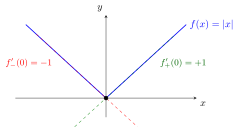
The graph has a corner at . The left derivative is and the right derivative is , as shown by the dashed tangent lines, so does not exist. Each one-sided derivative is the slope of a tangent from one side; the corner is the visible sign that the two slopes differ.
Approach from one side only: the one-sided quotients settle at and . For the presets they differ and for the right quotients grow without bound. For custom formulas finite difference quotients do not determine a limit.
At an interior point, is differentiable if and only if both one-sided derivatives exist and are equal, because a two-sided limit exists exactly when both one-sided limits exist and agree. At an endpoint of a closed interval only one side is available, and the one-sided derivative takes the place of the derivative. A one-sided derivative can also fail to exist because the quotients grow without bound: for at the right quotient is , which tends to , a vertical tangent.
A common slip is to compute as , the limit of the derivative function. The two can differ. For with , the right quotient tends to , so , but has no limit as .
Key Results
- Existence of both one-sided derivatives does not guarantee differentiability.
- One-sided derivatives may exist even when the two-sided derivative does not.
- Equality of left and right derivatives implies differentiability.
- One-sided derivatives are not the same as the one-sided limits of the derivative function.
Examples
- The function has distinct one-sided derivatives at
- Boundary points often admit only one-sided derivatives.
Prerequisites
Related Concepts
Sources
- Math I: Calculus · Lecture 6
Aliases: right derivative, left derivative, right-differentiable, left-differentiable Symbols: element of, infinity, real numbers, square root, subset
Last updated: 27 October 2026 11:52
One-Sided DerivativeDerivative and DifferentiabilityOne-Sided LimitOne-Sided Continuity