Squeeze Theorem for Sequences
Theorem
Let and be sequences of real numbers such that for all Suppose also that and converge to the same limit Then also converges to
Interpretation
The squeeze theorem proves convergence by trapping: a sequence caught between two sequences with the same limit has nowhere else to go. It is the standard tool when is hard to handle directly but easy to bound by simpler sequences.
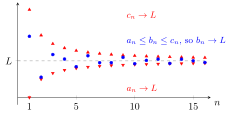
In the figure, approaches from above and from below, while the middle sequence oscillates around . The oscillation does not matter: always stays between and , and the gap between them shrinks to .
Shrink : from the index where both and are inside the band, is trapped inside too, so it converges to the same .
Both hypotheses are needed. The outer limits must be equal: lies between and but alternates between and . Both bounds are needed too: satisfies with , yet diverges. The inequalities only have to hold from some index on, since finitely many terms do not affect a limit. Unlike the monotone convergence theorem, the theorem needs no monotonicity, and it gives both the existence and the value of the limit.
In practice the theorem is often used in the form with , which is the theorem with and . For example, gives . The same trapping argument returns later for functions in the squeeze theorem for functions.
Key Results
- The middle sequence must lie termwise between two convergent sequences.
- Equality of outer limits enforces convergence of the middle sequence.
- The theorem does not require monotonicity.
Examples
- If then
Prerequisites
Related Concepts
Sources
- Math I: Calculus · Lecture 3
Aliases: sandwich theorem for sequences Keywords: sandwich theorem, squeeze theorem Symbols: epsilon, infinity
Last updated: 20 October 2026 03:02
Squeeze Theorem for SequencesLimit of a SequenceInequalitySqueeze Theorem for FunctionsComparison Test for SeriesBounded Sequence