Limit of a Sequence
Definition
Let A sequence converges to if for every there exists an such that for every we have In this case, the sequence is called convergent, and is called its limit. We write
If no such exists, the sequence is called divergent.
Interpretation
The limit of a sequence describes the value approached by its terms as the index increases. The definition formalizes "approached" as eventual closeness: however small a tolerance is chosen, from some index on every term lies within of .
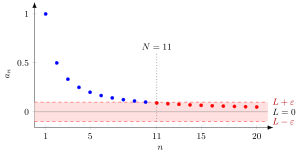
: for , every term with (red) lies within of the limit , since exactly when . A smaller needs a larger : for , works. The definition asks only that some exists for each , not the smallest one.
Shrink and watch grow. Then move the candidate away from the limit, or pick : no keeps every later term in the band.
The order of the quantifiers carries the meaning: first is given, then may be chosen depending on , and the condition must hold for all . This last part rules out sequences that only come close now and then. The terms of equal infinitely often but also return to , so for no keeps all later terms within of any candidate . Only the tail matters: changing finitely many terms does not change whether the limit exists or what it is.
Two slips are common. "The terms get closer and closer to " is not the definition: the terms of also get closer to at every step, but is not the limit. And the terms need not approach from one side: converges to while jumping from one side of to the other. The same -idea returns later for limits of functions, as a limit at a point.
Key Results
- Limits of sequences are unique when they exist.
- Every convergent sequence is bounded.
Enrichment: non-assessable in 2026-27
Every convergent sequence is a Cauchy sequence, and over the converse also holds. The Cauchy criterion is optional enrichment in Math I: Calculus and is not part of the assessable sequence-limit core.
Examples
- The sequence does not converge.
Proving a sequence limit with and
Prove from the definition that .
Simplify the distance to the limit
For every ,
Find a simpler bound and choose
Since , we have , and as soon as . So, given , choose an integer with ; it exists by the Archimedean property of the real numbers.
Verify the choice
For every ,
This holds for every , so the sequence converges to .
Takeaway. Simplify first, then bound it by something simple that shrinks as grows, and read off that bound. may depend on , and it does not have to be the smallest possible one.
Prerequisites
Related Concepts
Sources
- Math I: Calculus · Lecture 3
Aliases: sequence limit Keywords: convergent sequence, convergence of a sequence Symbols: element of, epsilon, infinity, real numbers
Last updated: 27 October 2026 11:52
Limit of a SequenceEuler's NumberInfinite SeriesLimit Laws for SequencesMonotone Convergence TheoremSqueeze Theorem for SequencesConvergence in a Metric SpaceLimit Superior and Limit InferiorPointwise ConvergenceAlmost-Sure ConvergenceConvergence in DistributionConvergence in ProbabilityExponential LimitStability of a Scalar Difference EquationSequenceCauchy SequenceBounded SequenceLimit at InfinityMonotone SequenceSubsequenceReal Number