Singularity
Definition
A point is called a singularity of a function if fails to be defined or continuous at while being defined and continuous in a punctured neighbourhood of
Lecture 5 classifies these problem points by their one-sided limits:
- Removable: the finite limit exists, but is missing or has the wrong value.
- Jump: both one-sided limits are finite but unequal.
- Infinite: at least one one-sided limit is or
- Oscillatory: a one-sided limit fails because of persistent oscillation.
Interpretation
A singularity marks a point where a function fails to behave regularly, although it is defined and continuous at all points close to it. The question is what goes wrong at that single point, and the one-sided limits answer it.
The four types can be read as a sequence of questions. If both one-sided limits are finite and equal, the singularity is removable: defining or redefining as the common limit makes continuous at . If they are finite but different, no value of helps, and the jump has size . If one of them is infinite, the graph has a vertical asymptote at . If a one-sided limit fails to exist because the values keep oscillating, the singularity is oscillatory.
A typical removable singularity: is undefined at but has limit there, so setting the value at gives a function that is continuous on all of .
A common slip concerns points outside the domain. The function is continuous at every point of its domain ; what fails at is that cannot be extended to a function continuous at . Calling a discontinuity of should be read in this sense, not as a point of the domain where continuity fails.
The word returns later with improper integrals, where a function that is unbounded near a point, such as near , is integrated by taking a limit.
Key Results
- At an interior point, is continuous if and only if a discontinuity is exactly a failure of this equality.
- Several distinct things can go wrong at may be undefined while nearby values behave well; may be defined but not continuous; nearby values may become unbounded; or nearby values may oscillate without approaching anything.
- The word singularity returns in Lecture 12 for improper integrals: an integrand may be unbounded at an interior singularity, and the integral is then split there.
Examples
- The function has a removable discontinuity at
- The piecewise function for and for has a jump discontinuity at so does the signum function at the origin.
- The function has an infinite discontinuity at
- The function has an oscillatory discontinuity at
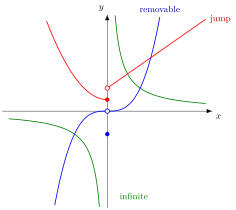
The three graphs illustrate singularities at . The first is removable because changing the assigned value to the limit restores continuity; the second has unequal one-sided limits and ; and the third, , has an infinite singularity.
Prerequisites
Related Concepts
Sources
- Math I: Calculus · Lectures 5 and 12
Keywords: discontinuity, types of discontinuity, removable discontinuity, jump discontinuity Symbols: infinity, real numbers, square root
Last updated: 20 October 2026 03:02
SingularityContinuityDomainLimit at a PointVertical AsymptoteZero of a Function