Mean Value Theorem
Theorem
Let be real numbers, and consider a function that is continuous on and differentiable on Then, we can assert that there exists a such that
Interpretation
The mean value theorem links the average rate of change of over an interval with its instantaneous rate of change: somewhere strictly between and , the derivative equals the slope of the secant through and . If a car covers km in one hour, then at some moment its speed is exactly km/h.
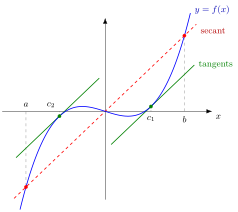
The figure shows on . The secant has slope , and gives . These are the points and , where the tangents are parallel to the secant. The theorem promises at least one such point; it says nothing about how many there are or where they lie.
Move and : for a preset satisfying the theorem’s hypotheses there is a point where the tangent is parallel to the secant. With and the hypothesis fails, and so can the conclusion.
Both hypotheses are needed. Without continuity at an endpoint the conclusion can fail: on with has secant slope , but on . Without differentiability at a single interior point it can fail too: for on the secant slope is , while the derivative only takes the values and . Differentiability at the endpoints themselves is not required.
Rolle’s theorem is the special case , and the general theorem follows from it by subtracting the secant line from . In practice the theorem is used in the form from the Key Results, which turns information about into information about : the sign of gives monotonicity, and a bound on an interval gives for all in it.
Key Results
- The theorem requires continuity on a closed interval and differentiability on the open interval.
- It justifies the derivative sign test. Applying the theorem on gives for some so the sign of on the interior determines whether is increasing, decreasing, or constant.
- Two functions with the same derivative. If are continuous on and differentiable on with on then on for some constant The domain has to be an interval for this to hold.
- The version above is Lagrange's mean value theorem, and it is what "the mean value theorem" means in this course. The two-function version due to Cauchy, which underlies L'Hôpital's rule, is optional and non-assessable.
- It generalizes Rolle’s theorem.
- The conclusion does not specify the location of the point.
Examples
- For on , the secant slope is . Solving gives .
- For on any interval with , the secant slope and derivative both equal , so every satisfies the conclusion.
Using the mean value theorem to prove an inequality
Prove that for all real numbers and .
Set up an interval
If both sides are . Otherwise, swapping the names if needed, assume ; the inequality is symmetric in and . The function is continuous on and differentiable on , with .
Apply the theorem
The mean value theorem gives a with
Bound the derivative
Since ,
Takeaway. The mean value theorem turns a bound on into a bound on differences of : if on an interval, then there. You never need to know where is.
Prerequisites
Related Concepts
- Rolle’s Theorem
- Monotone Function: the sign of the derivative determines the sign of each secant slope.
Sources
- Math I: Calculus · Lecture 7
Aliases: MVT, Lagrange's mean value theorem, Lagrange mean value theorem, law of the mean Symbols: element of, real numbers, square root
Last updated: 27 October 2026 11:52
Mean Value TheoremContinuityDerivative and DifferentiabilityRolle’s TheoremMonotone Function