Triangle Inequality
Proposition
For all real numbers and
Interpretation
The triangle inequality bounds the size of a sum by the sizes of its parts: is never more than . It formalizes the idea that direct paths are never longer than indirect ones: walking and then ends at distance from , after covering a total length of .
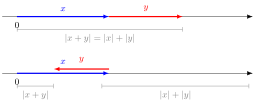
In the top diagram, and have the same sign, so . In the bottom diagram their signs are opposite, so the displacements partly cancel. In general, equality holds precisely when , including the case where either value is zero.
Walk , then : when they have the same sign the lengths add up exactly, and when the signs differ part of the walk is undone, so .
Applied to differences, the inequality becomes a statement about three points on the line. Writing gives
so the distance from to is at most the distance via a third point . This is the form used most often: to show that two numbers are close, compare both with a third number. Applying the inequality to and to also gives the reverse triangle inequality .
A common slip is to expect ; it fails for and , where it would say . The correct bounds are . The name becomes literal later, for the side lengths of a triangle formed by vectors in Math II.
Key Results
- Absolute values interact subadditively under addition.
- The inequality provides fundamental bounds in analysis.
Examples
- for all real numbers
Prerequisites
Related Concepts
Sources
- Math I: Calculus · Lecture 2
Last updated: 20 October 2026 03:02
Triangle InequalityMetric and Metric SpaceNorm and Normed Vector SpaceAbsolute ValueTriangle Inequality for Vector Norms