Triangle Inequality for Vector Norms
Theorem
For vectors , the triangle inequality states .
Interpretation
The triangle inequality says that the direct route is never longer than a detour: the length of one side of a triangle is at most the sum of the lengths of the other two sides.
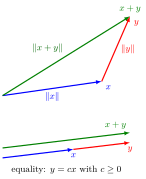
In the upper triangle, starts at the tip of , so the third side is , and its length is strictly smaller than . In the flattened triangle below, with points the same way as , and the lengths add exactly. For nonzero vectors this is the only case of equality; equality also holds when either vector is the zero vector.
Drag and : going straight to is never longer than going via . Equality needs to point the same way as .
The inequality follows from the Cauchy-Schwarz inequality. Expanding with the inner product gives , and Cauchy-Schwarz bounds the middle term by , so the right-hand side is at most . Equality needs , an angle of between nonzero vectors.
For the Euclidean norm is the absolute value, and the statement is the triangle inequality for numbers. Applied to , it says that for the Euclidean distance a stop at never shortens the trip: . Later it becomes one of the rules that every norm must satisfy.
The inequality is only an upper bound: for and the sum is , with norm , not .
Key Results
- The triangle inequality follows from the Cauchy-Schwarz inequality.
- It is one of the defining properties of a norm.
Examples
- .
- If and point in the same direction, equality can hold.
Prerequisites
Related Concepts
Sources
- Math II: Linear Algebra · Week 5
Keywords: Minkowski inequality Symbols: element of, real numbers, square root
Last updated: 20 October 2026 03:02
Triangle Inequality for Vector NormsEuclidean NormCauchy-Schwarz InequalityEuclidean DistanceTriangle Inequality