Complex Addition
Definition
Given two complex numbers and where , the sum of complex numbers and is defined as
Interpretation
Complex numbers are added part by part: real parts with real parts and imaginary parts with imaginary parts. Nothing beyond the addition of real numbers is needed.
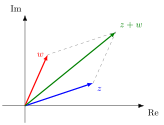
Draw and as arrows from . A copy of the arrow placed at the tip of ends at , since real parts and imaginary parts add separately. The two arrows and their copies form the dashed parallelogram, and is its diagonal from .
Drag and : real parts add, imaginary parts add, just like vector addition.
Because the addition works coordinate by coordinate, it is commutative and associative, is the identity and the negation is the inverse of , so is an Abelian group. Adding a fixed shifts every point of the plane by the same arrow; multiplication instead rotates and stretches. The parallelogram rule returns later for the addition of vectors.
Key Results
- The additive identity for complex numbers is which is the real number
- Complex addition has commutativity:
- Complex addition has associativity: .
Examples
- .
- .
Prerequisites
Related Concepts
Sources
- Math II: Linear Algebra · Week 1
Aliases: addition of complex numbers, sum of complex numbers Symbols: complex numbers, element of, real numbers
Last updated: 20 October 2026 03:02
Complex AdditionComplex SubtractionComplex NumberComplex MultiplicationCartesian Representation of Complex NumbersField