Distributivity
Definition
Let and be binary operations on a set . The operation is left distributive over if
for all , and right distributive over if
for all . It is distributive over if it is both left and right distributive.
Interpretation
Distributivity is the rule for multiplying out brackets, and read backwards, for factoring out a common factor. It is the law that connects two operations, whereas associativity and commutativity each concern a single operation.
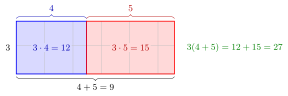
The figure reads the first example, , as areas. A rectangle of height and width has area ; cutting it where the width ends splits it into rectangles of areas and . Multiplying out the brackets is this cut, and factoring out the common factor is gluing the two rectangles back together.
Drag and and change the scalars. Adding first and then scaling lands on the same point as scaling first and then adding: these are the two distributive laws of a vector space.
If is commutative, left and right distributivity are equivalent. For a non-commutative operation such as the matrix product of Week 3, both laws must be stated.
The order of the two operations matters: " distributes over " is a different statement from " distributes over ". Multiplication of real numbers distributes over addition, but addition does not distribute over multiplication. Many algebra slips come from applying a distributive law that does not hold, such as splitting into .
Key Results
- A ring, and therefore a field, requires multiplication to be distributive over addition. Distributivity is the only ring axiom that links the two operations.
- In any ring, : distributivity gives , and adding to both sides leaves . The same argument on the right gives .
- In any ring, : by distributivity , so is the additive inverse of . In particular .
- Repeated use gives the general laws and ; the second needs both the left and the right law.
- The vector space axioms of Week 2 contain two distributive laws for scalar multiplication: and . Here the operations combine elements of two different sets, scalars and vectors.
Examples
- Multiplication of real numbers distributes over addition: .
- Complex multiplication distributes over complex addition, which is how products are expanded: .
- For sets, intersection distributes over union and union distributes over intersection: and .
- Addition of real numbers does not distribute over multiplication: , but .
- A one-sided law: on define . Then , so is right distributive over ; but while , so it is not left distributive.
- Division is right distributive over addition, for , but not left distributive: , whereas .
- For powers of positive reals, , so exponentiation is right distributive over multiplication; but , whereas .
- For matrices of compatible sizes, the matrix product distributes over matrix addition on both sides: and .
Prerequisites
Related Concepts
Sources
- Math II: Linear Algebra · Week 1
Aliases: distributive law, distributive property, distributive Keywords: left distributivity, right distributivity, distributes over, multiplying out brackets, factoring out Symbols: alpha, beta, element of, intersection, real numbers, union
Last updated: 17 October 2026 21:53
DistributivityRingBinary OperationAssociativityCommutativityFieldComplex MultiplicationMatrix Product