Point-Normal Equation of a Plane
Definition
The point-normal equation of a plane through with normal vector is .
Interpretation
The point-normal equation describes a plane by a test rather than a recipe: a point lies on the plane exactly when the displacement from the fixed point is orthogonal to the normal vector .
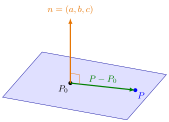
In the figure the displacement lies in the plane and stands perpendicular to it. Writing this with the inner product and expanding the coordinate sum gives the defining equation: . For a point off the plane, the displacement has a component along and the left-hand side is nonzero.
Expanding further gives with . The coefficients of form the normal vector, and the constant fixes the position: changing while keeping shifts the plane parallel to itself. One equation in three unknowns leaves two free variables, matching the two parameters of the parametric description. For the plane of the Examples, ; choosing and gives , which recovers and as direction vectors.
The same pattern in , , describes a line with normal , and in a hyperplane. In linear programming, the boundary of a constraint is such a plane, with the coefficient vector as its normal.
A common slip is to treat the equation as unique. Multiplying by a nonzero number, as in , describes the same plane, because the normal vector is only fixed up to a nonzero multiple.
Key Results
- It can be rewritten as , where .
- The normal vector is read from the coefficients of .
Examples
- A plane through with normal has equation .
- For , and , a normal satisfies and . Taking gives and the plane .
Prerequisites
Related Concepts
Sources
- Math II: Linear Algebra · Week 5
Aliases: point-normal form, normal form of a plane, point-normal equation Symbols: real numbers
Last updated: 20 October 2026 03:02
Point-Normal Equation of a PlaneNormal VectorInner ProductPlaneHyperplaneDistance Between a Point and a Line