Aleph Null
Definition
Aleph null, denoted , is the cardinality of the natural numbers:
Interpretation
is the name for the size of the set of natural numbers. A set has this size exactly when its elements can be listed as a sequence in which every element appears exactly once, that is, when it is countably infinite.
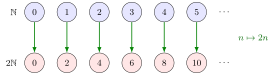
The figure pairs each natural number with . Every natural number gets exactly one partner and every even number is hit exactly once, so is a bijection from onto the even numbers . Hence also has cardinality , although it is a proper subset of that misses every odd number. For infinite sets, being a part does not mean being smaller.
The same listing idea explains the cardinal arithmetic . Adding one element to still gives a list . Two disjoint countably infinite sets can be listed together by taking elements from each in turn, and can be listed along the finite diagonals . Ideas of this kind show that and have cardinality as well.
Not every infinite set has this size: by Cantor's diagonal argument the real numbers cannot be listed, and the cardinality of the continuum is strictly larger. So is one particular infinite size, not the same as the symbol from calculus, which describes unbounded growth rather than the size of a set.
Key Results
- A set has cardinality exactly when it is countably infinite.
- A bijection is the main tool for proving that two sets have the same cardinality.
Examples
- , , and all have cardinality .
Prerequisites
Related Concepts
- Countable and Uncountable Sets
- Power Set
- Cantor's Theorem
- Cantor's Diagonal Argument
- Cardinality of the Continuum
Sources
- Math II: Linear Algebra · Week 1
Aliases: aleph-nought, aleph-zero, aleph 0, aleph-naught Keywords: countable infinity Symbols: infinity, integers, natural numbers, rational numbers
Last updated: 20 October 2026 03:02
Aleph NullContinuum HypothesisNatural NumberCardinalityCountable and Uncountable SetsPower SetCantor's TheoremCantor's Diagonal ArgumentCardinality of the Continuum