Complex Negation
Definition
Given a complex number where , the negation of the complex number is defined as
Interpretation
Negating a complex number changes the sign of both its real and its imaginary part: real negation is applied separately to and . Then , so is the additive inverse of .
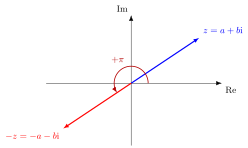
The arrows to and have the same length and point in opposite directions: is the mirror image of through the origin, reached by the half-turn marked . This matches complex multiplication: , and has length and angle , so multiplying by it rotates by without stretching.
Drag : is its mirror image through the origin.
Negation should not be confused with the complex conjugate , which changes only the sign of the imaginary part and reflects in the real axis. For one has but .
Key Results
- and are symmetric about the origin in the complex plane.
Examples
- .
- .
Prerequisites
Related Concepts
Sources
- Math II: Linear Algebra · Week 1
Aliases: negative of a complex number Symbols: element of, pi, real numbers
Last updated: 20 October 2026 03:02
Complex NegationComplex SubtractionComplex NumberNegationComplex AdditionComplex Conjugate