Complex Conjugate Root Theorem
Theorem
If is a polynomial in one variable with real coefficients, and is a root of with and being real numbers, then its complex conjugate is also a root of .
Interpretation
For a polynomial with real coefficients, the non-real roots come in pairs : whenever is a root, so is its mirror image in the real axis.
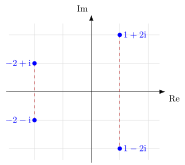
The four plotted points are the roots of , a polynomial with real coefficients. They form the two conjugate pairs and , and each dashed segment joins a root to its mirror image. Each pair gives a real quadratic factor: .
With real coefficients the roots are mirrored in the real axis. Give an imaginary part and the symmetry breaks: the theorem needs real coefficients.
The proof uses that conjugation respects sums and products, and , and leaves real numbers unchanged. If with real and , then . The step is where real coefficients are needed; without them the pairing can fail, as the polynomial in the Examples shows.
For a non-real root , the product is a real quadratic factor of , so non-real roots can be split off in pairs. Together with the fundamental theorem of algebra, this shows that every real polynomial is a product of real linear and real quadratic factors, and that a real polynomial of odd degree has a real root, as the Key Results state. The theorem returns later for eigenvalues: the non-real eigenvalues of a real matrix also come in conjugate pairs.
Key Results
- If the degree of a real polynomial is odd, it must have at least one real root.
- Any real square matrix with odd (so its characteristic polynomial has odd degree ) has at least one real eigenvalue.
Examples
- has real coefficients and the root , so is also a root.
- has the root but not : its coefficients are not all real, so the theorem does not apply.
Prerequisites
Related Concepts
- Root of a Polynomial
- Characteristic Polynomial
- Eigenvalue and Eigenvector
- Fundamental Theorem of Algebra
Sources
- Math II: Linear Algebra · Week 1
Aliases: conjugate root theorem, complex conjugate zeros theorem Symbols: lambda
Last updated: 20 October 2026 03:02
Complex Conjugate Root TheoremComplex Conjugate Pair of EigenvaluesComplex ConjugateRoot of a PolynomialCharacteristic PolynomialEigenvalue and EigenvectorFundamental Theorem of Algebra