LU Decomposition
Definition
An LU decomposition factors a matrix, after possible row permutations, as , where is a permutation matrix, is lower triangular, and is upper triangular.
Interpretation
LU decomposition records the forward phase of Gaussian elimination (row reduction to row echelon form) as a matrix factorization: is the echelon form that elimination produces, and stores the multipliers used to get there.
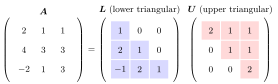
The figure factors
Subtracting times row 1 from row 2, adding row 1 to row 3 (multiplier ), and then subtracting times the new row 2 from row 3 leaves ; the multipliers , , fill below its diagonal of ones.
Multiplying undoes the elimination and rebuilds row by row. For instance, row 3 of is times row 1 of , plus times row 2, plus row 3: . Since and are triangular, the factorization also gives the determinant: .
To solve , first solve by forward substitution, then by back substitution. The elimination is done once, so each further right-hand side costs only these two triangular solves. Row swaps are needed when a zero appears in a pivot position: has no decomposition , since its first pivot would be , but swapping its rows gives . When no row swaps are needed, .
A common slip concerns the signs in . Its entries are the multipliers in "subtract times row from row ", so adding row 1 to row 3 enters as , not .
Key Results
- If no row interchanges are needed, the factorization is .
- LU decomposition helps solve efficiently by forward and back substitution.
Examples
- For , subtract and times row 1 from rows 2 and 3, then times the new row 2 from row 3. This gives , the multipliers fill , and .
- includes pivoting through the permutation matrix .
Prerequisites
Related Concepts
Sources
- Math II: Linear Algebra · Week 5
Aliases: LU factorization, LU factorisation, PLU decomposition
Last updated: 20 October 2026 03:02
LU DecompositionTriangular MatrixPermutation MatrixMatrix ProductGauss-Jordan EliminationPivotSystem of Linear EquationsElementary Row Operation