Complex Exponentiation
Definition
Let and be complex numbers. The complex power is defined as , where the complex logarithm is a multivalued function. The principal value of the complex exponentiation is , where denotes the principal value of the complex logarithm.
Interpretation
For real numbers, when . The complex power uses the same recipe: take a logarithm of the base, multiply it by the exponent , and apply the complex exponential function. Because has infinitely many values, can have many values too.
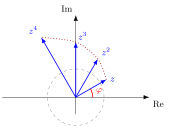
For an integer exponent nothing new happens. The figure shows for with and : each further factor stretches the length by and turns by , so the points move outwards along a spiral. This is De Moivre's formula: has modulus and argument .
has values, evenly spaced on a circle of radius . The highlighted one is the principal value .
The values of differ by multiples of , so the values of differ by factors with . How many different values arise depends only on . For an integer all these factors equal , and is single-valued. For with a positive integer there are factors , giving the different -th roots of . For an irrational or non-real , the values are all different, so there are infinitely many, as for in the Examples.
The usual rules for powers need care. With principal values, can fail: for , and , the left side is , but . For positive real and real , the principal value agrees with the real power.
Key Results
- Complex exponentiation is generally multivalued. For an integer exponent , changing by multiplies the result by , so is single-valued.
Examples
-
The square roots of : for ,
so has the two values and .
-
where
Prerequisites
Related Concepts
Sources
- Math II: Linear Algebra · Week 1
Aliases: complex power, principal value of complex exponentiation Symbols: element of, integers, phi, pi, real numbers, square root
Last updated: 22 October 2026 19:04
Complex ExponentiationComplex LogarithmComplex NumberDe Moivre's FormulaComplex Exponential FunctionEuler's FormulaEuler's Identity