Symmetric Group
Definition
The symmetric group of degree , denoted , is the set of all permutations of an -element set, equipped with permutation composition.
Interpretation
collects every possible rearrangement of objects into one group, with composition as the operation: doing one rearrangement after another is again a rearrangement, doing nothing is the identity , and every rearrangement can be undone by its inverse permutation.
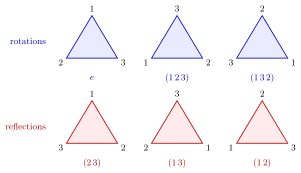
The figure shows the six elements of as the ways to relabel the corners of a triangle. The top row contains the identity and the two cycles and , which turn the triangle. The bottom row contains the three swaps , and ; each keeps one label in place and exchanges the other two, like a reflection. The group operation is not commutative: composing right to left, sends to , while sends to . So is not an Abelian group, and it is the smallest group with this property.
The size follows by counting: the image of can be chosen in ways, then the image of in ways, and so on, which gives the factorial . The same count of orderings appears in probability as the number of arrangements of distinct objects. For the group is commutative. For it is not, since the two swaps above, acting only on the first three objects, still do not commute in .
Key Results
- has elements.
- is a group.
Examples
- contains all six permutations of a three-element set.
- In , let swap and , and let swap and . Applying the rightmost permutation first gives but . Thus these elements do not commute.
Prerequisites
Related Concepts
- Permutation Matrix
- Abelian Group: is not Abelian when , as the example shows.
- k-Permutation
Sources
- Math II: Linear Algebra · Week 1
Aliases: symmetric group on n letters Keywords: permutation group Symbols: sigma, tau
Last updated: 20 October 2026 03:02
Symmetric GroupPermutationGroupPermutation MatrixAbelian Groupk-Permutation