Vector
Definition
A vector is an element of a vector space. In coordinate spaces such as , a vector is often represented as an ordered list of coordinates.
A vector written vertically as an matrix is called a column vector. A vector written horizontally as a matrix is called a row vector.
Interpretation
A vector is an element of a vector space: something that can be added to other vectors of the same space and multiplied by a scalar. In it is an ordered list of numbers, which can be read as a point, an arrow, a displacement or simply a list of data.
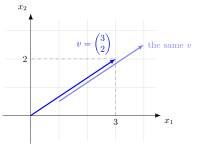
The blue arrow from the origin to the point represents ; the dashed lines show its two coordinates, steps along the -axis and along the -axis. The lighter arrow starts at and makes the same steps, so it represents the same vector: an arrow is fixed by its direction and length, not by where it starts.
Drag the tip of : its two coordinates are the steps along the axes, and the same vector can be written as a column or, transposed, as a row.
Writing a vector as a column or as a row matters only in matrix calculations. As an matrix, a column vector is what a matrix multiplies in a linear system , and row vectors usually appear as transposes of column vectors.
The general definition is wider than lists of numbers: matrices and polynomials are vectors too, because they can be added and scaled within their own vector spaces. A common slip is to identify a vector with its list of coordinates. Coordinates depend on a chosen basis; only for the standard basis of are they the entries of the list itself.
Key Results
- Vectors can be added and multiplied by elements of the underlying field when they belong to a vector space.
- The transpose of a column vector is a row vector, and the transpose of a row vector is a column vector.
Examples
- is a column vector in .
- is a row vector.
Prerequisites
Related Concepts
Sources
- Math II: Linear Algebra · Weeks 2–3
Keywords: vectors, column vector, row vector, coordinate vector, displacement vector Symbols: real numbers
Last updated: 20 October 2026 03:02
VectorInner ProductLinear Dependence and IndependenceParametric Representations of Lines and PlanesPlaneQuadratic FormReal Coordinate SpaceSystem of Linear EquationsEuclidean NormDirectional DerivativeGradientConvex Set in R^nThird-Order Derivative TensorVelocity Vector of a CurveVector SpaceVector AdditionScalar MultiplicationMatrixLinear CombinationCoordinate