Cartesian Representation of Complex Numbers
Definition
The complex plane or -plane is the plane formed by the complex numbers, with a Cartesian coordinate system such that the horizontal -axis, called the real axis, is formed by the real numbers, and the vertical -axis, called the imaginary axis, is formed by the purely imaginary numbers. The form is called the Cartesian form of a complex number.
Interpretation
The complex plane draws each complex number as the point of the Cartesian plane. It can therefore be seen as the plane equipped with additional structure, such as complex multiplication.
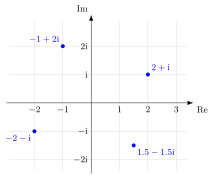
Each plotted point is read off the grid: lies to the right and up, lies to the left and up, and and lie below the real axis because their imaginary parts are negative. The label on the vertical axis marks the number , one unit up; its coordinate is the real number .
Each complex number is the point . Drag along the axes to see the real and the purely imaginary numbers.
The two axes separate the parts of a number: the real axis holds the numbers with , the imaginary axis those with , and they meet at . Operations that work part by part have simple pictures here. Complex addition shifts a point by an arrow, the conjugate reflects it in the real axis, and the modulus is its distance from by Pythagoras, for example .
Multiplication has no such simple description in coordinates. It becomes clear in the polar form, which describes the same point by its distance from and its angle. The Cartesian form is the natural one for adding, the polar form for multiplying.
Key Results
- Each complex number corresponds to unique coordinates .
- In the Cartesian coordinate system, the addition of complex numbers can be visualized as vector addition.
Examples
- and are elements in the complex plane .
- For , the real part is , the imaginary part is , and .
Prerequisites
Related Concepts
Sources
- Math II: Linear Algebra · Week 1
Aliases: Complex Plane (Cartesian Coordinate System), Argand plane, Argand diagram, complex plane, z-plane, Gaussian plane Keywords: Cartesian form, rectangular form, algebraic form Symbols: complex numbers, real numbers, square root
Last updated: 20 October 2026 03:02
Cartesian Representation of Complex NumbersComplex NumberCartesian Coordinate SystemPolar Representation of Complex NumbersComplex AdditionComplex SubtractionImaginary Unit