2-Argument Arctangent
Definition
The 2-argument arctangent, denoted as , is a function defined by
Interpretation
The function answers the question: in which direction does the point lie, seen from the origin? It returns the angle in measured from the positive -axis, which is the principal argument of the complex number .
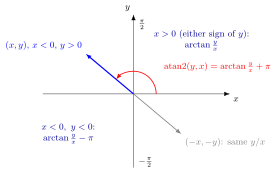
The blue point lies in the second quadrant, with and . The grey point has the same ratio , so the inverse tangent gives both points the same angle in , namely the direction of the grey point. For the blue point the definition adds , half a turn, which gives the correct direction.
Drag the point into the left half-plane: only sees the slope, while adds or subtracts to give the true direction.
Each case of the definition repairs one defect of . For the point lies in the right half-plane, where the range of is already correct. For the angle is shifted by , upwards when and downwards when , so that the result stays in ; points on the negative -axis get , not . For the ratio is not defined, and the angle is read off directly. At the origin there is no direction at all, so no value is assigned.
In practice, is how the polar form of is found: and . Python provides it as math.atan2(y, x). Note the order of the arguments: comes first, as in the ratio .
Key Results
- The range of is , covering all four quadrants.
- is continuous at every point that does not lie on the negative real axis. Crossing the negative real axis (, ), it jumps by : just below the axis its values are close to , on and just above the axis they are close to .
Examples
- (second quadrant).
- (third quadrant, within range ).
Prerequisites
Related Concepts
Sources
- Math II: Linear Algebra · Week 1
Aliases: atan2, two-argument arctangent, arctangent with two arguments, arctan with two arguments, arctangent with 2 arguments, arctan with 2 arguments, arctan2 Symbols: phi, pi, square root
Last updated: 22 October 2026 19:04
2-Argument ArctangentInverse Trigonometric FunctionsComplex NumberArgument of a Complex NumberPolar Coordinate System