Countable and Uncountable Sets
Definition
A set is countably infinite if it has the same cardinality as the natural numbers, equivalently if there is a bijection between the set and
A set is countable if it is finite or countably infinite. A set that is not countable is called uncountable.
Course convention
In Math II: Linear Algebra, countable includes finite sets. Use countably infinite when the set must be infinite and in bijection with
Interpretation
A countable set is one whose elements can be listed as a first, a second, a third element and so on, with every element appearing somewhere. An uncountable set is too large for this: every sequence indexed by the natural numbers misses some of its elements.
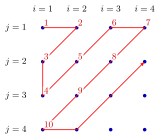
The zigzag runs through the pairs along the diagonals on which is constant. The pair gets the number , the pairs and get and , the diagonal with gets , and , and so on. Each diagonal is finite, so every pair receives a number, and different pairs receive different numbers. This is a bijection between the numbers and the pairs, so is countably infinite, although it looks larger than .
Repeated entries in a list can be skipped: reading as the fraction and skipping repeats such as , the zigzag lists every positive rational number; adding and the negatives shows that is countable. Uncountability is harder to show, since every possible list must fail: Cantor's diagonal argument builds, from any list of numbers in , a number not on it.
A common slip is to treat infinite and uncountable as the same. , and are infinite but countable, of size aleph null; is strictly larger and has the cardinality of the continuum.
Key Results
- Every finite set is countable.
- Every subset of a countable set is countable.
- , , and are countably infinite.
- Cantor's diagonal argument shows that and are uncountable.
Examples
- is countable because it is finite.
- The even natural numbers are countably infinite: gives a bijection from .
- The real interval is uncountable.
Prerequisites
Related Concepts
Sources
- Math II: Linear Algebra · Week 1
Aliases: countable set, uncountable set, uncountably infinite, at most countable Symbols: integers, natural numbers, rational numbers, real numbers
Last updated: 20 October 2026 03:02
Countable and Uncountable SetsCantor's Diagonal ArgumentDiscrete Random VariableCoverUnion and Intersection of Closed SetsUnion and Intersection of Open SetsCardinalityNatural NumberAleph NullCardinality of the ContinuumFinite and Infinite SetsInfinityContinuum Hypothesis