Normal Vector
Definition
A normal vector to a plane is a nonzero vector perpendicular to every direction vector in the plane.
Interpretation
A normal vector records which way a plane faces. The direction vectors say how one can move inside the plane; the normal vector points straight out of it, so it fixes the tilt of the plane but not its position.
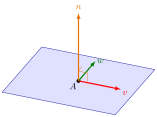
In the figure, stands at a right angle to both direction vectors at the point , so . Every displacement inside the plane is a linear combination , and . Checking the two independent directions is therefore enough to be perpendicular to the whole plane.
To find a normal vector , solve and , as in the second example of the point-normal equation. In one can also take the cross product . Any nonzero multiple of a normal vector is again normal, and in all normals of one plane are multiples of each other.
Two planes in are parallel or equal exactly when their normals are multiples of each other. The same idea gives the normal of a hyperplane in .
A common slip is to expect the normal vector to be orthogonal to the points of the plane. It is orthogonal to differences of points, as in the Key Results; itself is the same for every point of the plane, and it is only when the plane passes through the origin.
Key Results
- A point and a normal vector determine a plane in .
- If is normal to a plane and is a point of the plane, then for every point on the plane.
Examples
- For the -plane, is a normal vector.
- If a plane has direction vectors , then a normal vector is orthogonal to both and .
Prerequisites
Related Concepts
Sources
- Math II: Linear Algebra · Week 5
Aliases: normal Keywords: surface normal, vector perpendicular to a plane Symbols: real numbers
Last updated: 20 October 2026 19:41
Normal VectorHyperplanePoint-Normal Equation of a PlaneOrthogonal VectorsPlaneInner ProductDistance Between a Point and a LineSkew Lines