Pivot
Definition
A pivot of a nonzero row is the first nonzero entry in that row.
Interpretation
A matrix arranges the coefficients into rows and columns; finding the first nonzero entry of a row identifies its pivot position and the corresponding column.
Pivots mark the leading variables and structure of an echelon form.
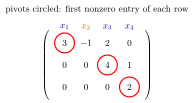
Blue columns hold a pivot: are basic (pivot) variables; the orange column has none: is a free variable, which can take any value, and the basic variables are then determined by it. The number of pivots is the rank; in echelon form each pivot sits to the right of the one above.
Key Results
- In row echelon form, each pivot lies to the right of the pivot in the row above.
- In reduced row echelon form, every pivot is a leading and is the only nonzero entry in its column.
Examples
- In , the pivot is .
- In , the pivot is .
Prerequisites
Related Concepts
Sources
- Math II: Linear Algebra · Week 3
Aliases: pivot element, pivot entry Keywords: leading entry, leading coefficient
Last updated: 20 October 2026 03:02
PivotRow Echelon and Reduced Row Echelon FormMatrixGauss-Jordan EliminationElementary Row OperationRankLU Decomposition