Definiteness and Eigenvalues
Theorem
For a real symmetric matrix , definiteness is completely determined by the signs of the eigenvalues: positive definite means all eigenvalues are positive, positive semidefinite means all are nonnegative, negative definite means all are negative, negative semidefinite means all are nonpositive, and indefinite means both positive and negative eigenvalues occur.
Interpretation
Eigenvalues reveal the sign behaviour of a symmetric matrix's quadratic form. The theorem replaces a condition on all nonzero vectors by a check of numbers.
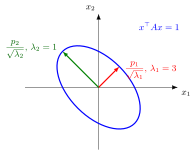
The figure shows the ellipse for a symmetric matrix with eigenvalues and . Its axes lie along the unit eigenvectors and , which are orthogonal, and have half-lengths and . The larger eigenvalue gives the shorter axis, because the form grows faster in that direction.
On the unit circle runs between the two eigenvalues, reached along the eigenvectors. Their signs decide the definiteness.
For a unit eigenvector with , the form takes the value , so a negative eigenvalue rules out positive definiteness. A real symmetric matrix has real eigenvalues and mutually orthogonal unit eigenvectors, which form the columns of an orthogonal matrix , with and . In the coordinates the form becomes , and its signs can be read from the .
Symmetry matters. The non-symmetric has the single eigenvalue , yet gives . The test must be applied to the symmetric matrix of the form, here , whose eigenvalues and show that the form is indefinite.
For a symmetric matrix the eigenvalues need not be computed: their product is and their sum is the trace, so is positive definite if and only if and . A test with determinants of upper-left submatrices for every returns later as Sylvester's criterion.
Key Results
- This theorem converts a quadratic-form problem into an eigenvalue problem.
- It applies to real symmetric matrices.
Examples
- A diagonal matrix with diagonal entries and is positive definite.
- A diagonal matrix with diagonal entries and is indefinite.
Prerequisites
Related Concepts
Sources
- Math II: Linear Algebra · Week 6
Aliases: eigenvalue test for definiteness Symbols: lambda, square root
Last updated: 20 October 2026 03:02
Definiteness and EigenvaluesDefinite MatrixEigenvalue and EigenvectorSymmetric MatrixQuadratic FormDiagonalizationOrthogonal Matrix