Orthogonal Matrix
Definition
A real matrix is orthogonal if
where is the identity matrix. Equivalently, is invertible with , so also .
Interpretation
The entry of is the inner product of columns and of . So says exactly that the columns form an orthonormal basis of , and says the same of the rows. The name is traditional: the columns must be orthonormal, not merely orthogonal. The diagonal matrix has orthogonal columns but is not an orthogonal matrix.
Geometrically, is a rigid motion that fixes the origin: it preserves lengths, angles and distances. In every orthogonal matrix is a rotation or a reflection in a line through the origin.
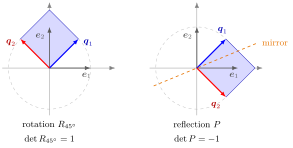
Both panels start from (grey); the images (blue) and (red) are the columns of , and the shaded square is the image of the unit square. On the right is the matrix from the Examples, which is with : it reflects in the line at (orange) and has . On the left the sign of its second column is swapped, which gives the rotation with determinant . In both cases the columns stay on the unit circle and at a right angle, so lengths and angles are preserved; only the orientation of the square differs, and that is what the sign of records.
Turn and drag : under or the unit circle maps onto itself and , while shows up as a mirrored F. Move the length of the second column away from : the columns stay orthogonal, but , the circle becomes an ellipse and lengths change. Switch on to see that it undoes exactly when is orthogonal.
Orthogonal matrices make changes of basis cheap: if the new basis is orthonormal, its transformation matrix is orthogonal and the inverse needed for new coordinates is just the transpose, . This is why they appear in central factorizations. A symmetric matrix can be diagonalized by an orthogonal matrix, with orthonormal eigenvectors as the columns of . In Week 7, the singular value decomposition of an arbitrary matrix also uses orthogonal and .
A rectangular matrix with and orthonormal columns satisfies but not ; is then the orthogonal projection onto its column space. The word "orthogonal matrix" is reserved for the square case.
Key Results
- preserves inner products and lengths: , hence . Conversely, a square matrix with for all is orthogonal.
- , since by the product rule for the determinant. In and , gives a rotation and includes a reflection. The converse fails: has determinant but is not orthogonal, since its second column has length .
- Every (possibly complex) eigenvalue of has ; the only possible real eigenvalues are and .
- Products, inverses and transposes of orthogonal matrices are orthogonal: . Sums generally are not: is not orthogonal.
- A linear system with orthogonal is solved by , without elimination; equivalently, .
- Every permutation matrix is orthogonal.
- Applying the Gram-Schmidt algorithm to any basis of and placing the resulting vectors as columns produces an orthogonal matrix.
Examples
Rotations and reflections in . For an angle ,
Both have orthonormal columns because . rotates by and has ; reflects in the line at angle and has .
For example, maps to ; both vectors have length , and their dot product confirms the right angle.
Checking a matrix. Let
Each column has squared length , and the columns are orthogonal, for instance ; so and . Expanding the determinant gives . In fact for and for every : is the reflection in the plane orthogonal to .
Diagonalizing a symmetric matrix. For , the eigenvalues are and with unit eigenvectors and . With
is orthogonal and with : no matrix inversion is needed. Here ; swapping the sign of one column gives a rotation instead.
Prerequisites
Related Concepts
- Change of Basis
- Gram-Schmidt Algorithm
- Orthogonal Projection
- Singular Value Decomposition
- Symmetric Matrix
- Permutation Matrix
Sources
- Math V: Advanced Linear Algebra · Week 6 (placement provisional; not yet checked against the slides)
Aliases: orthogonal matrices, orthogonal transformation, orthonormal matrix Keywords: Q^T Q = I, Q^{-1} = Q^T, det Q = ±1, orthonormal columns, rotation matrix, reflection matrix, length-preserving, isometry Symbols: lambda, pi, real numbers, sigma, square root, theta
Last updated: 17 October 2026 21:53
Orthogonal MatrixSingular Value DecompositionOrthonormal BasisTransposeInverse and Singular MatricesDeterminantChange of BasisGram-Schmidt AlgorithmOrthogonal ProjectionSymmetric MatrixPermutation Matrix