Stability of a Scalar Difference Equation
Proposition
Consider the linear difference equation of order with constant coefficients and constant right-hand side
with characteristic polynomial and , so that is the unique equilibrium. The equilibrium is called (globally) asymptotically stable if every solution converges to , whatever the initial values. This holds if and only if every characteristic root satisfies .
- First order, with : asymptotically stable if and only if .
- Second order, : asymptotically stable if and only if and .
Interpretation
The deviation solves the homogeneous equation, so it is a combination of terms . Each term tends to exactly when the modulus is below ; the polynomial factor from a repeated root cannot prevent decay. One root with is enough to spoil convergence for some initial values.
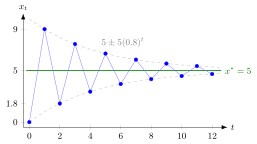
The figure shows the first example below, with . Because is negative, jumps to alternate sides of ; because , the distance shrinks every period, so the path stays inside the dashed envelope and converges to .
Move across and follow the cobweb: each period multiplies the distance to by , so every starting value converges when and moves away when .
The definition quantifies over all initial values. An unstable equation can still have particular solutions that converge, namely those whose coefficients on the large roots happen to be zero.
In Math V, asymptotic stability (all solutions converge) requires all roots strictly inside the unit circle. The equation is called stable when all solutions stay bounded: all roots satisfy and those with are simple. Such roots give solutions that neither grow nor die out, so the equation is stable but not asymptotically stable. Compare the continuous-time criterion for the stability of an equilibrium of an ordinary differential equation, where decay requires (negative real parts for linear systems) rather than a modulus below .
Key Results
- For the first-order equation, . For the approach is monotone, for it is a damped oscillation, for the path diverges unless , and for it is a two-cycle.
- A pair of simple nonreal roots gives oscillations with amplitude proportional to : damped if , constant if , explosive if .
- Necessary conditions for asymptotic stability: (since ) and .
- The speed of convergence is set by the largest root modulus .
- If , is a root, there is no unique equilibrium and the equation is not asymptotically stable.
Examples
Damped oscillation. has and . From : , , approaching from alternating sides. Asymptotically stable, since .
Asymptotically stable with complex roots. : here , , and , . Directly: with .
Unstable, yet some solutions converge. has roots and ; the test fails because . The general solution diverges unless ; for instance , gives .
Prerequisites
- First-Order Linear Difference Equation
- Characteristic Polynomial for a Difference Equation
- Limit of a Sequence
- Complex Absolute Value
Related Concepts
- Stability of a System of Linear Difference Equations
- Second-Order Linear Difference Equation
- Higher-Order Linear Difference Equation
- Stability of an Equilibrium
Sources
- Math V: Advanced Linear Algebra · Week 2
Aliases: stability of a linear recurrence, asymptotic stability of a difference equation Keywords: |a| < 1, all characteristic roots inside the unit circle, |a_0| < 1 and |a_1| < 1 + a_0, global asymptotic stability, damped oscillation Symbols: product, rho, square root, theta
Last updated: 17 October 2026 21:53
Stability of a Scalar Difference EquationStability of a System of Linear Difference EquationsFirst-Order Linear Difference EquationCharacteristic Polynomial for a Difference EquationLimit of a SequenceComplex Absolute ValueSecond-Order Linear Difference EquationHigher-Order Linear Difference EquationStability of an Equilibrium