Complex Number
Definition
A complex number is of the form , where and are real numbers, and is the imaginary unit. The number is the real part of the complex number and is denoted by . Similarly, is the imaginary part and is represented as If the real part of a complex number is zero, we term the number as a purely imaginary number. The set of all complex numbers is denoted by
Interpretation
Essentially, a complex number is an ordered pair of two real numbers, its real part and its imaginary part . Writing it as lets one calculate as with ordinary algebraic expressions, using the extra rule .
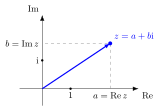
The point lies units along the horizontal axis and units up the vertical axis, so the two parts are its coordinates. The marked points and are the units of the two axes: the real numbers fill the horizontal axis and the purely imaginary numbers the vertical one. This picture is the complex plane.
Drag : the real part is measured along the horizontal axis and the imaginary part along the vertical one.
Both parts are real numbers: for the imaginary part is , not . A real number is the complex number , which is how should be read, and two complex numbers are equal if and only if their real parts are equal and their imaginary parts are equal.
What is gained is solvability: has no real solution but the two solutions in , and by the fundamental theorem of algebra every nonconstant polynomial has a root in . What is lost is order. No order on follows the rules of the order on , since in such an order every square would be at least , while . Sizes are compared through the modulus instead.
Key Results
- Complex numbers do not have trichotomy, e.g., we cannot say or
- Complex numbers extend the real numbers by adding a solution of .
Examples
- is a complex number.
- Any real number is a special complex number, but not every complex number is real, i.e., .
Prerequisites
Related Concepts
Sources
- Math II: Linear Algebra · Week 1
Symbols: complex numbers, real numbers, subset
Last updated: 20 October 2026 03:02
Complex Number2-Argument ArctangentArgument of a Complex NumberComplex Absolute ValueComplex AdditionComplex ConjugateComplex DivisionComplex Exponential FunctionComplex ExponentiationComplex LogarithmComplex MultiplicationComplex NegationCartesian Representation of Complex NumbersPolar Representation of Complex NumbersComplex ReciprocalComplex SubtractionComplex Trigonometric FunctionsEuler's FormulaEuler's IdentityFundamental Theorem of AlgebraSecond-Order Linear Difference EquationReal NumberImaginary UnitFieldAlgebraically Closed FieldDe Moivre's Formula