Skew Lines
Definition
Skew lines are two lines in or higher dimensions that do not intersect and are not parallel.
Interpretation
Write the two lines in parametric form as and . They intersect only if these vectors are equal for some ; skewness requires that this system have no solution and that their directions not be parallel.
Skew lines show that higher-dimensional geometry has line relationships not possible in the plane.
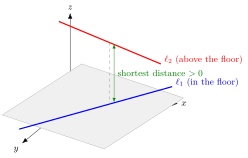
The illustrated lines are skew: their directions are independent, but they have no common point. Skew lines can occur only in dimension at least ; in a plane, two non-parallel lines always meet.
Key Results
- Skew lines require dimension at least .
- Two skew lines are neither parallel nor intersecting.
Examples
- The -axis and the line through in direction are skew in .
- Two lines in cannot be skew.
Prerequisites
Related Concepts
Sources
- Math II: Linear Algebra · Week 5
Aliases: non-coplanar lines, skew line Symbols: real numbers
Last updated: 20 October 2026 03:02
Skew LinesParametric Representations of Lines and PlanesPlaneVectorNormal VectorEuclidean Space