Parametric Representations of Lines and Planes
Definition
A parametric representation of a line in has the form
where is a point on the line, is a direction vector, and .
A parametric representation of a plane has the form
where is a point on the plane and are linearly independent direction vectors.
Interpretation
Scalar multiplication turns the parameters into displacements , and . Their linear combinations, added to the starting point , trace out the line or plane.
The parameters describe movement from a starting point along one direction for a line, or along two independent directions for a plane.
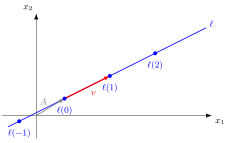
In , , the point lies on the line and is its direction. Equally spaced parameter values give equally spaced points. Choosing another point on the line or a nonzero multiple of gives another representation of the same line.
Move : walks along the line, through at and at . Drag and the tip of to move the line.
Key Results
- A point lies on the line or plane exactly when it is obtained for some parameter value or parameter pair.
- Two distinct points determine a line, while three non-collinear points determine a plane.
Examples
- represents a line through .
- represents a plane in .
Prerequisites
Related Concepts
Sources
- Math II: Linear Algebra · Week 5
Aliases: vector equation of a line, vector equation of a plane Keywords: parametric equation of a line, parametric line, parametric representation of a plane, parametric equation of a plane, parametric plane Symbols: element of, real numbers
Last updated: 20 October 2026 03:02
Parametric Representations of Lines and PlanesDistance Between a Point and a LineSkew LinesVectorLinear CombinationScalar MultiplicationPlaneAffine Map