Root of a Polynomial
Definition
Let be a polynomial with coefficients in a field . A scalar is a root or zero of if
Interpretation
A root is an input at which the polynomial evaluates to zero: it is the zero of a function when that function is the polynomial . The defining test is evaluation at the proposed root, not a zero coefficient of .
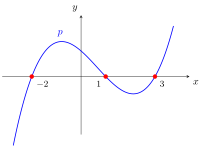
The graph of meets the -axis exactly at the red points , and . Each root comes from a factor: at the factor is zero, so the whole product is zero. Conversely, polynomial long division shows that is a root if and only if divides , so finding roots and splitting off linear factors are the same task. Since each root splits off a factor of degree one, a nonzero polynomial of degree has at most roots.
The field in the definition matters. The polynomial has no root in , since for every real , but over it has the roots and , because . By the fundamental theorem of algebra, every nonconstant polynomial with complex coefficients has a root in , which is one reason why the complex numbers are convenient scalars in linear algebra.
This returns later in the course: the eigenvalues of a square matrix are the roots of its characteristic polynomial.
Key Results
- A field is algebraically closed if every nonconstant polynomial over it has a root in that field.
- Dividing by a nonzero polynomial gives unique with and either or . In particular, is a root of if and only if divides ; the multiplicity of the root is the largest such that divides .
Examples
- is a root of .
- For , the roots are and .
Prerequisites
Related Concepts
Sources
- Math II: Linear Algebra · Week 1
Aliases: zero of a polynomial, polynomial zero, polynomial root Symbols: complex numbers, element of, lambda, real numbers
Last updated: 20 October 2026 03:02
Root of a PolynomialFundamental Theorem of AlgebraCharacteristic Equation for a Differential EquationCharacteristic Polynomial for a Difference EquationPolynomialZero of a FunctionCharacteristic PolynomialEigenvalue-Root TheoremPolynomial Long Division