Cardinality of the Continuum
Definition
The cardinality of the continuum, often denoted , is the cardinality of the real numbers:
Interpretation
is the size of the real line. It is an infinite size strictly larger than , the size of (see aleph null): by Cantor's diagonal argument the real numbers cannot be listed as a sequence, so is uncountable.
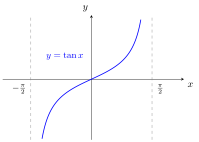
On the open interval the graph of is continuous and increasing, with a vertical asymptote at each end, so every real height is reached exactly once. Hence is a bijection, and this short interval has as many points as the whole real line: length plays no role in cardinality. In the same way maps bijectively onto any open interval with .
Less obviously, , the cardinality of the power set of . Roughly, a number in has a binary expansion , which corresponds to the set of positions with digit . Even has no more points than .
Between any two real numbers lies a rational number, yet only has cardinality . So the extra points are the irrational numbers: if they formed a countable set, would be countable too. Whether some set has a size strictly between and is the continuum hypothesis.
Key Results
Examples
- The interval has cardinality .
Prerequisites
Related Concepts
Sources
- Math II: Linear Algebra · Week 1
Aliases: continuum cardinality, cardinality of the real numbers, beth one Keywords: cardinality of R Symbols: natural numbers, pi, rational numbers, real numbers
Last updated: 20 October 2026 03:02
Cardinality of the ContinuumContinuum HypothesisReal NumberCardinalityCantor's Diagonal ArgumentAleph NullCantor's TheoremCountable and Uncountable Sets