Kernel
Definition
Let be a linear map. The kernel or null space of is .
Interpretation
The kernel contains all input vectors that the linear map sends to the zero vector. It measures what the map loses: two inputs have the same image exactly when their difference lies in the kernel, since if and only if .
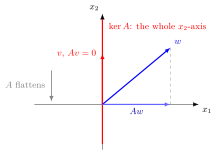
The matrix flattens the plane onto the -axis: goes straight down to , and every vector on the -axis, such as , goes to . So , the whole -axis.
Drag onto the dashed line: there . The kernel is only when .
For a matrix, finding the kernel means solving the homogeneous system by row reduction. Each free variable contributes one basis vector, so the dimension of the kernel is the number of free variables. The kernel also describes every other solution set: if , the solutions of are exactly plus a vector of the kernel.
In particular, a linear map is injective if and only if its kernel is , and the fundamental theorem of linear maps links the dimension of the kernel to that of the range.
A common slip is to conclude "the kernel is " after checking only that . The zero vector lies in every kernel; the question is whether any other vector does. Note also that the kernel is a subspace of the domain , not of .
Key Results
- The kernel of a linear map is a subspace of the domain.
- A linear map is injective exactly when its kernel is .
Examples
- For , the kernel is .
- The kernel of the identity map is .
Prerequisites
Related Concepts
Sources
- Math II: Linear Algebra · Week 4
- Math V: Advanced Linear Algebra · Week 5 (revisited)
Aliases: null space, nullspace Symbols: element of, real numbers
Last updated: 20 October 2026 03:02
KernelFundamental Theorem of Linear MapsGeneralized EigenvectorAffine SubspaceFundamental Theorem of Linear AlgebraLinear MapSubspaceZero VectorHomogeneous and Inhomogeneous SystemsRankJordan Blocks and ChainsRange of a Linear Map