Vector Space
Definition
A vector space over a scalar field (commonly or ) is a set, whose elements are called vectors, equipped with the operations of vector addition and scalar multiplication that satisfy the following properties:
Let .
- Closure under addition: .
- Associativity of addition: .
- Additive identity: There exists a zero vector such that .
- Commutativity of addition: .
- Additive inverse: There exists such that .
Let and .
- Closure under scalar multiplication: .
- Associativity of scalar multiplication: .
- Distributive property over vector addition: .
- Distributive property over scalar addition: .
- Scalar multiplication identity: For the multiplication identity , we have .
Real and complex vector spaces
A real vector space is a vector space over the field . A complex vector space is a vector space over the field , so its scalars may be complex numbers.
Interpretation
A vector space is a collection of objects you can add together and multiply by numbers, with all the usual algebraic rules you would expect.
It is the basic setting for linear algebra.
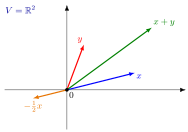
In the diagram, adding and gives , and multiplying by reverses its direction and halves its length. Both results remain in . The same axioms also apply to polynomial and function spaces and to the solution set of ; every subspace is itself a vector space.
Key Results
- The additive identity is unique.
- If , then . This is known as the cancellation law.
Examples
- is the most common vector space.
- The set of all real matrices, under matrix addition and scalar multiplication, is also a vector space.
Prerequisites
Related Concepts
Sources
- Math II: Linear Algebra · Week 2
- Math V: Advanced Linear Algebra · Week 5 (revisited)
Aliases: linear space Symbols: alpha, beta, complex numbers, element of, real numbers
Last updated: 20 October 2026 03:02
Vector SpaceBasisCoordinateEigenvalue and EigenvectorEuclidean SpaceFinite-Dimensional Vector SpaceLinear MapLinear OperatorLinear SpanReal Coordinate SpaceScalar MultiplicationSpanning ListSubspaceVector AdditionVectorZero VectorAffine MapEquivalent NormsNorm and Normed Vector SpaceDifference EquationSecond-Order Differential EquationFieldLinear CombinationMatrix AdditionMatrix Scalar MultiplicationDistributivity