Cofactor Expansion
Theorem
For a square matrix , let be the matrix obtained by deleting row and column . The number is the minor of entry , and
is the corresponding cofactor.
The determinant can be computed by expanding along any row or column:
for expansion along row , or
for expansion along column .
Interpretation
Cofactor expansion reduces the determinant of an matrix to determinants of size , each multiplied by an entry of the chosen row or column and by a sign. Repeating the step ends at determinants; the determinant itself is defined this way, along the first row.
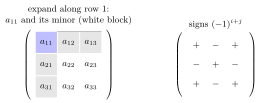
Expanding a matrix along row gives . Deleting row and column (shaded) leaves the white block , whose determinant is the minor of . The sign of each cofactor is read off the checkerboard on the right: on the main diagonal, alternating along every row and column.
Since every row and every column gives the same value, the choice is purely practical: an entry removes the term without computing its minor. A full expansion of an determinant produces products, so for larger matrices one first creates zeros, for example by adding a multiple of one row to another, which does not change the determinant, and then expands along the sparse row or column.
For matrices the expansion gives the same six products as Sarrus' rule, and the cofactors are the entries of the adjugate matrix, which gives a formula for the inverse.
A common slip is to drop the sign: . The sign depends only on the position , not on the sign of the entry .
Key Results
- Cofactor expansion can be performed along any row or column.
- Choosing a row or column with many zeros makes the computation shorter.
Examples
- For a matrix, expanding along the first row gives three determinants.
- For a diagonal matrix, expanding along sparse rows quickly gives the product of diagonal entries.
Prerequisites
Related Concepts
Sources
- Math II: Linear Algebra · Week 4
Aliases: Laplace expansion, expansion by minors Keywords: minor, cofactor, expansion along a row, expansion along a column Symbols: sum
Last updated: 20 October 2026 03:02
Cofactor ExpansionAdjugate MatrixDeterminantMatrixSarrus' RuleInverse and Singular Matrices