Equivalent Systems of Equations
Definition
Two systems of equations are equivalent if they have the same solution set.
Interpretation
Two systems are equivalent when they have exactly the same solutions, so they contain the same mathematical information even if their equations look different. Solving a system means replacing it by ever simpler equivalent systems until the solutions can be read off.
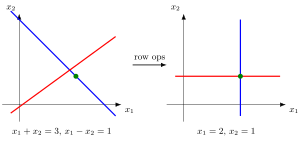
On the left, the lines and meet at . The row operation gives , scaling by gives , and then gives . On the right these two equations are a vertical and a horizontal line: different lines, but they meet in the same point, so the solution set is unchanged.
Every gives a different-looking system with the same solution set: the systems are equivalent.
The definition compares only solution sets; the number of equations, their order and their coefficients may all differ. Adding the equation , the sum of the two original equations, gives a system of three equations that is still equivalent to the original two. Elementary row operations produce equivalent systems because each can be undone. Steps that cannot be undone may change the solution set: has solution set , but after squaring, has solution set .
Because "having the same solution set" is reflexive, symmetric and transitive, equivalence of systems is an equivalence relation. Note that any two systems without solutions are equivalent, since both have the empty set as solution set, even if they share no equation.
Key Results
- Elementary row operations produce equivalent systems.
- Solving a system by elimination means replacing it by easier equivalent systems.
Examples
- , is equivalent to , .
- Swapping the order of equations gives an equivalent system.
Prerequisites
Related Concepts
Sources
- Math II: Linear Algebra · Week 3
Aliases: equivalent linear systems
Last updated: 20 October 2026 03:02
Equivalent Systems of EquationsSystem of Linear EquationsSolution SetElementary Row OperationRow Echelon and Reduced Row Echelon FormGauss-Jordan Elimination