Direct Sum
Definition
Let be subspaces of , and let . If every can be written in exactly one way as
with , then is the direct sum of the subspaces, denoted
Interpretation
A direct sum is a sum of subspaces in which every vector of the sum has only one decomposition: knowing determines each piece . The subspaces do not overlap in a way that would allow a vector to be split in two different ways.
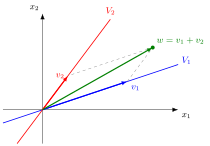
In the figure, and are two different lines through the origin of . The parallelogram rule writes as with on and on , and because the two lines meet only at , there is no other way to do it. Every vector of the plane can be split like this, so .
For two subspaces, uniqueness is equivalent to . If a nonzero lay in both, then and would be two different decompositions of . Conversely, if , then lies in both subspaces, so it is and the two decompositions agree. The idea is the same as in linear independence: uniqueness everywhere follows from uniqueness for .
For three or more subspaces, checking the intersections in pairs is not enough. In , the lines spanned by , and meet pairwise only in , yet is both and , so their sum is not direct.
Key Results
- For two subspaces, is direct exactly when .
Examples
- The -axis and -axis form a direct sum equal to .
- Let and . The vector has the decomposition . Any decomposition forces and , so it is unique.
Prerequisites
Related Concepts
- Linear Dependence and Independence: uniqueness of the decomposition is the absence of a nontrivial relation between components.
- Dimension: for finite-dimensional subspaces, .
Sources
- Math II: Linear Algebra · Week 2
Keywords: internal direct sum, external direct sum Symbols: element of, intersection, real numbers
Last updated: 20 October 2026 03:02
Direct SumOrthogonal ComplementSum of SubspacesSubspaceLinear Dependence and IndependenceDimension