Inverse and Singular Matrices
Definition
For a square matrix , an inverse matrix is a matrix such that
If such a matrix exists, then is invertible, nonsingular, or nondegenerate. If no inverse exists, then is singular, non-invertible, or degenerate.
Interpretation
An inverse matrix undoes the action of a linear map: if sends to , then sends back to . Singular matrices are precisely those whose action cannot be undone: they send some nonzero vector to , so different inputs share an output.
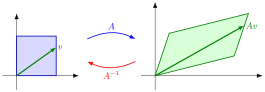
maps the unit square onto the parallelogram spanned by its columns and onto ; the arrow labelled leads back, for every . This is possible because the parallelogram is not flattened: is invertible if and only if .
sends back to (ringed). Choose the singular example: two different vectors go to the same place, and no inverse exists.
The defining equalities use matrix products, which represent composition of linear maps, and the identity matrix, which leaves every vector unchanged. So says that first and then changes nothing, and says the same in the other order. For square matrices either equality already implies the other, and an inverse, when it exists, is unique.
An inverse makes every system uniquely solvable, with . To compute it, row-reduce by Gauss-Jordan elimination to , or use the cofactor formula of the adjugate matrix.
Two slips are common. The inverse of a product reverses the order, : to undo "first , then ", undo first. And is not the matrix of reciprocals : has a zero entry, yet its inverse is .
Key Results
- If and are invertible, then .
- A square matrix is invertible if and only if its determinant is nonzero, if and only if it has full rank.
- If is invertible, then .
Examples
- is its own inverse.
- is singular because its rows are dependent.
Prerequisites
Related Concepts
Sources
- Math II: Linear Algebra · Week 4
- Math V: Advanced Linear Algebra · Week 1 (revisited)
Aliases: matrix inverse Keywords: invertible matrix, nonsingular matrix, non-singular matrix, singular matrix, non-invertible matrix, degenerate matrix, nondegenerate matrix, inverse matrix
Last updated: 20 October 2026 03:02
Inverse and Singular MatricesImplicit Function TheoremChange of BasisGeneralized InverseOrthogonal MatrixSimilarity TransformationMatrixIdentity MatrixMatrix ProductDeterminantAdjugate MatrixGauss-Jordan EliminationLinear MapRank