Orthogonal Vectors
Definition
Two vectors and are orthogonal if their inner product is zero: .
Interpretation
Two nonzero orthogonal vectors meet at a right angle in Euclidean geometry. The inner product turns this geometric condition into a computation: instead of measuring an angle, multiply matching coordinates, add, and check whether the result is .
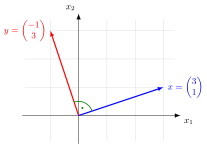
The vectors and in the figure satisfy , so the angle between them is . Here is turned a quarter turn; in the vectors and are always orthogonal. Pythagoras holds as well: has .
Turn until , or press the button: for two nonzero vectors, the shadow of on the line of disappears and they meet at a right angle. A zero vector is also orthogonal by definition, but has no angle.
The link with Pythagoras holds in every dimension. Expanding gives , so the Euclidean norms add in squares exactly when . The definition also covers the zero vector: it is orthogonal to every vector, and it is the only vector orthogonal to itself, because . A right angle only makes sense for nonzero vectors.
Orthogonality defines the normal vector of a plane, and the shortest distance from a point to a line is measured along the perpendicular. It returns later in orthonormal bases, bases of mutually orthogonal vectors of length .
Orthogonal should not be confused with linearly independent. Nonzero vectors that are pairwise orthogonal are always independent, but independent vectors need not be orthogonal: and are independent, with inner product .
Key Results
- Orthogonality is equivalent to a angle for nonzero real vectors.
- If has unit length, then gives the signed length of the projection of onto .
Examples
- and are orthogonal.
- and are orthogonal.
Prerequisites
Related Concepts
Sources
- Math II: Linear Algebra · Week 5
Aliases: perpendicular vectors Keywords: orthogonality Symbols: real numbers
Last updated: 27 October 2026 11:52
Orthogonal VectorsNormal VectorGram-Schmidt AlgorithmOrthogonal ComplementOrthogonal ProjectionOrthonormal BasisInner ProductAngle Between VectorsEuclidean NormCauchy-Schwarz InequalityIdempotent Matrix