Euclidean Distance
Definition
The Euclidean distance between two points and in is .
Interpretation
Euclidean distance is the ordinary straight-line distance, inherited from the Euclidean norm: the distance between two points is the length of the vector from one to the other.
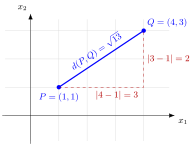
From to the coordinates change by horizontally and vertically. These differences are the legs of a right triangle, so by Pythagoras . In the formula adds one squared difference per coordinate.
Drag the points and : the distance is the length of , the hypotenuse of a right triangle with the coordinate differences as legs.
The squares remove the signs, so , and only when . For the formula reduces to , the distance on the real line given by the absolute value. A detour is never shorter: is the triangle inequality for the norm. OR Modelling uses these distances as edge lengths in a Euclidean network.
Key Results
- The distance between two points is the length of the vector connecting them.
- The distance from a point to a line is the minimum Euclidean distance from the point to points on the line.
Examples
- .
- .
Prerequisites
Related Concepts
Sources
- Math II: Linear Algebra · Week 5
Aliases: Euclidean metric, L2 distance Keywords: straight-line distance Symbols: real numbers, square root
Last updated: 20 October 2026 03:02
Euclidean DistanceDistance Between a Point and a LineEuclidean NormEuclidean SpaceInner Product