Euclidean Network
Definition
In the course's Euclidean network, cities have plane coordinates , an edge may join every pair of cities, and its length is
The resulting distances provide the weights for the minimum spanning tree problem.
Interpretation
Coordinates turn a location problem into a complete weighted network: every pair of cities is joined by an edge, and the length of that edge is the straight-line distance between the two points, computed with Pythagoras' theorem. These are straight-line lengths, not road distances or travel times.
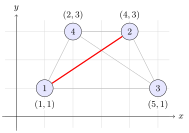
The four cities lie at the grid points , , and , and all pairs are joined. The red edge between cities 1 and 2 spans units horizontally and vertically, so . The coordinates only fix the edge lengths; they add no further connections.
With cities there are edges, so the seven-city example already needs 21 distances. Since , the network is undirected. Straight-line distances also have a useful property: going from to via a third city is never shorter than the direct edge, so in a Euclidean network the direct edge is always a shortest path between its endpoints.
Many distances are irrational numbers, and different edges can have equal or nearly equal lengths: in the figure, the edges and both have length . Rounding too early can therefore change the comparison between two close edges. Once the distances are computed accurately, the Dijkstra-Prim and Kruskal methods for a minimum spanning tree apply without change.
Key Results
- Distances are symmetric: .
- Use sufficient precision when comparing close distances.
- The usual spanning-tree algorithms apply once the distance matrix is computed.
Examples
The red edge has length . Euclidean distances satisfy the triangle inequality and can also be used as routing costs.
- Between and the distance is .
- The seven-city example has tree length about 27.29 using the displayed rounded distances.
Prerequisites
Related Concepts
Sources
- OR Modelling · Week 4
Symbols: square root
Last updated: 20 October 2026 03:02
Euclidean NetworkUndirected NetworkCartesian Coordinate SystemMinimum Spanning TreeDijkstra-Prim Method