Inventory Policy
Definition
An inventory policy specifies when to replenish stock and how much to order. Inventory theory constructs and analyses models to choose these decisions while accounting for demand and relevant costs.
Interpretation
An inventory policy answers two questions: when to order, and how much. Ordering often keeps stock low but triggers many setup costs; larger, less frequent orders save setups but keep more stock on hand. Which policy is best depends on these costs and on what is known about demand.
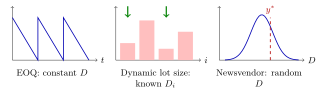
The three panels show three demand settings. On the left, demand runs at a constant known rate, and the EOQ policy repeats the same order whenever stock reaches zero. In the middle, demand is known but differs per period; orders, marked by arrows, are placed in only two of the four periods, so each order also covers the next period. On the right, demand is uncertain and only one quantity is chosen before it is observed.
Each setting leads to its own optimization model. The model fixes which decisions are allowed and which costs count: purchasing, setup, holding and, where unmet demand is allowed, shortage costs. The policy is the answer the model returns.
A policy is only complete when both parts are stated. "Order units" is not yet a policy without the trigger, such as "when stock reaches zero" in the classical EOQ model or a reorder level once there is a lead time.
Key Results
- The EOQ models use a constant deterministic demand rate.
- Dynamic lot sizing uses known demand varying by discrete period.
- The newsvendor model uses stochastic demand for one selling period.
- A complete policy states both the quantity and the ordering trigger or period.
Examples
- The left panel shows a classical EOQ policy: order when stock reaches zero, or at when a positive lead time requires ordering ahead.
- The middle panel shows dynamic lot sizing: order in selected periods to cover consecutive known demands .
- The right panel shows a newsvendor policy: choose one stock quantity before demand is observed, balancing the cost of having too little stock against the cost of having too much.
Prerequisites
Related Concepts
Sources
- OR Modelling · Week 5
Aliases: replenishment policy, ordering policy, inventory control policy
Last updated: 20 October 2026 03:02
Inventory PolicyDynamic Lot-Size ModelHolding CostNewsvendor ModelOrdering CyclePurchasing CostSetup CostShortage CostOptimization ModelClassical EOQ Model