Positive Part
Definition
For a real number , its positive part is
In the newsvendor model, is leftover stock and is unmet demand.
Interpretation
The positive part keeps a number when it is positive and replaces it by otherwise. In the newsvendor model it splits one difference into two counts that cannot be negative: leftover stock and unmet demand.
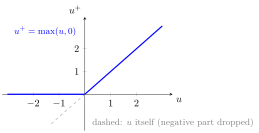
The graph is flat at height for and follows the line for ; the dashed piece of the line below zero is what the positive part cuts off. Like the absolute value, it has a corner at , and in fact .
A common slip is to compute as . For and the leftover is , not .
Key Results
- Both leftover and shortage quantities are nonnegative.
- For a fixed realized demand, at least one of them is zero.
- For discrete demand, expectations are computed by probability-weighting the positive parts for every demand outcome.
Examples
Defining the negative part by gives the identity .
- If and , leftovers are 3 and unmet demand is zero.
- If and , leftovers are zero and unmet demand is 2.
Prerequisites
- Real numbers
Related Concepts
Sources
- OR Modelling · Week 6
Aliases: ramp function, plus function, positive part function
Last updated: 20 October 2026 03:02
Positive PartDiscrete Newsvendor RuleNewsvendor ModelOverage CostUnderage Cost