Constraint
Definition
A constraint is a requirement that an allowed decision must satisfy. A linear functional constraint has the form
or the corresponding equality or inequality. The are constraint coefficients and is the right-hand side.
Interpretation
Constraints translate capacity limits, demand requirements, and other restrictions into mathematics. Feasibility requires all constraints to hold together.
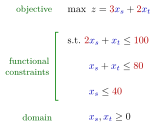
The objective function is the quantity to maximize (for example, profit) or minimize (for example, cost). Functional constraints describe what an allowed decision must satisfy, such as resource limits or demand requirements. Domain restrictions specify signs or integrality.
In the diagram, blue identifies decision variables, whose values the model determines; red identifies model parameters, the given data , and . In general, the model is subject to , where the constraints define the feasible set . A solution assigns values to all variables.
Key Results
- A capacity limit commonly gives a constraint; a minimum requirement commonly gives a constraint.
- An equality represents an exact requirement or balance.
- Multiplication by a negative number reverses an inequality.
Examples
- limits carpentry use in the Giapetto production model.
- requires enough calories in the diet problem, where are the pounds of feeds A and B.
Prerequisites
Related Concepts
Sources
- OR Modelling · Week 1
Symbols: element of
Last updated: 17 October 2026 21:53
ConstraintCapacity Expansion ModelCorner PointEither-Or ConstraintsFeasible SolutionLinear ProgrammingMaximum Flow ProblemModel ParameterNegative RHS TransformationNonnegativity ConstraintSlack VariableSurplus VariableDecision VariableFeasible Region