Optimization Bounds
Proposition
Suppose an optimization problem has a finite optimal value . Let be the value of a feasible solution and the finite optimal value of a relaxation with the same objective. Then
Interpretation
The two bounds trap the unknown optimum between a value that is known to be achievable and a value that cannot be beaten. Their difference measures how much the current feasible solution could still be improved, without knowing the optimum itself.
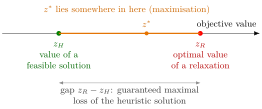
The figure is drawn for maximization. The value of a feasible solution lies on the left and the optimal value of a relaxation on the right; the unknown lies somewhere between them. The gap is the largest possible loss from accepting the feasible solution.
Each inequality has a short reason. The feasible solution is one of the points over which the optimum is taken, so the optimum is at least as good as . The relaxation optimizes the same objective over a larger set , so its optimum is at least as good as . This is why the relaxed value must be an optimal value and the other must come from a feasible point: an infeasible point says nothing about .
The direction words switch with the problem type, but the order does not: the feasible value is always on the worse side and the relaxed value on the better side. For minimization a heuristic gives an upper bound and a relaxation a lower bound; in the vehicle routing problem this gives miles.
Key Results
- For a minimization problem, .
- If the feasible and relaxed values coincide, the feasible solution is proven optimal.
- A feasible solution of a relaxation alone is not generally an opposing bound; its optimal value is needed.
Examples
For maximization, improved incumbents raise the feasible lower bound. Resolving branch-and-bound nodes can reduce the global upper bound formed from the incumbent and the remaining open-node relaxation bounds.
- The routing example gives , so the remaining improvement is at most 12 miles.
- A 232-mile route is also an upper bound, but 214 is tighter.
Prerequisites
Related Concepts
Sources
- OR Modelling · Week 1
Last updated: 20 October 2026 03:02
Optimization BoundsBranch-and-BoundHeuristicRelaxationIncumbent Solution