Shortest Path Problem
Definition
The course's shortest path problem is defined on a connected undirected network with nonnegative edge lengths, a specified origin, and a specified destination. It asks for a path between those vertices whose sum of edge lengths is minimum.
Interpretation
The shortest path problem asks for the best route between two given vertices of a network. The same formulation can minimize distance, travel time, fuel use, or any other route measure that adds up along the edges.
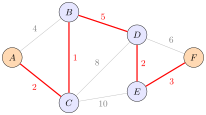
The highlighted route has length . It uses five edges, while uses only three but has length : the shortest path is the one of smallest total length, not the one with the fewest edges, and it may make a detour through extra vertices.
Each part of the definition has a role. The origin and destination fix which paths are compared, and the objective adds the edge lengths along a path. A measure that is not a sum, such as the smallest capacity along a route, does not fit this form. The nonnegative lengths match distances and times, and they are what the shortest path algorithm relies on when it fixes the distances one vertex at a time.
Shortest paths are also building blocks: they supply the pair costs in the Chinese postman problem. A shortest path should not be confused with a minimum spanning tree, which minimizes the total length of a network connecting all vertices rather than the length of one route. Later in the course, the problem is also written as a binary program.
Key Results
- The nonnegative-length assumption supports the course label-setting algorithm.
- Several different paths can have the same minimum length.
- The shortest-path tree from one origin and a minimum spanning tree solve different objectives.
Examples
In the figure, the red path has length 13. The alternatives , and have lengths 15, 15 and 16 respectively.
- The worked route S-B-A-D-E-T has length 12.
- In the CPP network, the shortest A-D route is A-C-D, of length 5, rather than the direct edge of length 6.
Prerequisites
Related Concepts
Sources
- OR Modelling · Week 4
Aliases: shortest route problem
Last updated: 20 October 2026 03:02
Shortest Path ProblemChinese Postman ProblemMinimum-Weight Perfect MatchingShortest Path AlgorithmShortest Path Binary FormulationPath in a NetworkUndirected NetworkMinimum Spanning Tree