Effective Lead Time
Definition
For a repeating EOQ ordering cycle of length and fixed lead time , the effective lead time is
Thus . The course's on-hand reorder level is .
Interpretation
The effective lead time says where in the stock cycle an order must be placed when the delivery delay is longer than one cycle. Whole cycles inside the delay do not change the position in the sawtooth, so only the remainder matters for the reorder level.
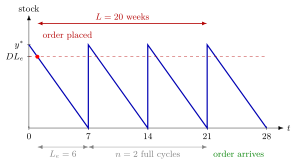
The cycle lasts weeks and the delay weeks. The order placed at week , when stock has fallen to , arrives at week : it spans the remainder weeks plus full cycles. Placing the order weeks before some stockout is therefore the right moment, even though the stockout it serves lies weeks ahead.
Whole cycles inside do not matter for the reorder level: only does. Make longer than a cycle to see orders overlap.
The number is the floor of : the number of complete cycles that fit into the delay. Subtracting them leaves , so the reorder level is always below the batch size and is actually reached by the on-hand stock. With , nothing is subtracted and .
A common slip is to use as the reorder level when exceeds a cycle: in the figure, is far above the maximum stock , a level the on-hand stock never reaches. The physical delay is still : only fixes the ordering moment, and when an order is placed, earlier orders are still on their way, as in EOQ with lead times.
Key Results
- For a lead time shorter than a cycle, .
- The quantity is a cycle remainder, not a shorter physical delivery delay.
- If the delay is an exact multiple of the cycle, the remainder is zero; ordering and receipt events must be interpreted at that common cycle boundary.
Examples
- In the figure, time is measured in weeks. A cycle of weeks gives . With weeks, and weeks, so the reorder level is . The order placed at week 1 arrives at week 21; two earlier orders are still in transit when it is placed.
- The snack bar has days and , giving days.
Prerequisites
Related Concepts
Sources
- OR Modelling · Week 5
Last updated: 20 October 2026 03:02
Effective Lead TimeEOQ with Lead TimesOrdering CycleEconomic Order Quantity