Mutually Exclusive Decisions
Definition
For binary variables , mutually exclusive decisions allow at most one variable to equal 1:
If one alternative must be chosen, use instead.
Interpretation
Mutually exclusive decisions describe options of which at most one may be chosen, such as building at most one of two warehouses. Because each is or , the sum counts the yes decisions, and the constraint is a statement about that count.
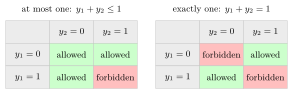
For two decisions the tables list all four combinations. "At most one", , forbids only ; "exactly one", , also forbids choosing neither. The inequality permits choosing none while the equality requires one choice, so the wording "at most one" or "exactly one" decides which version to use.
The same counting idea gives "at least of " in K-out-of-N constraints, and the exactly-one version selects a single listed value in a finite-value constraint.
Key Results
- Binarity is essential to interpret the sum as the number of yes decisions.
- Exactly one implies at most one, but the reverse is false.
- This restriction concerns decisions, not an either-or condition on continuous inequalities.
Examples
- With binaries and equal to 1 if a warehouse is built at location LA or SF, permits at most one warehouse.
- selects exactly one allowed quantity value.
Prerequisites
Related Concepts
Sources
- OR Modelling · Week 3
Aliases: mutually exclusive alternatives Symbols: sum
Last updated: 20 October 2026 03:02
Mutually Exclusive DecisionsFinite-Value ConstraintNonconvex Region ModellingBinary VariableContingent DecisionsEither-Or Constraints